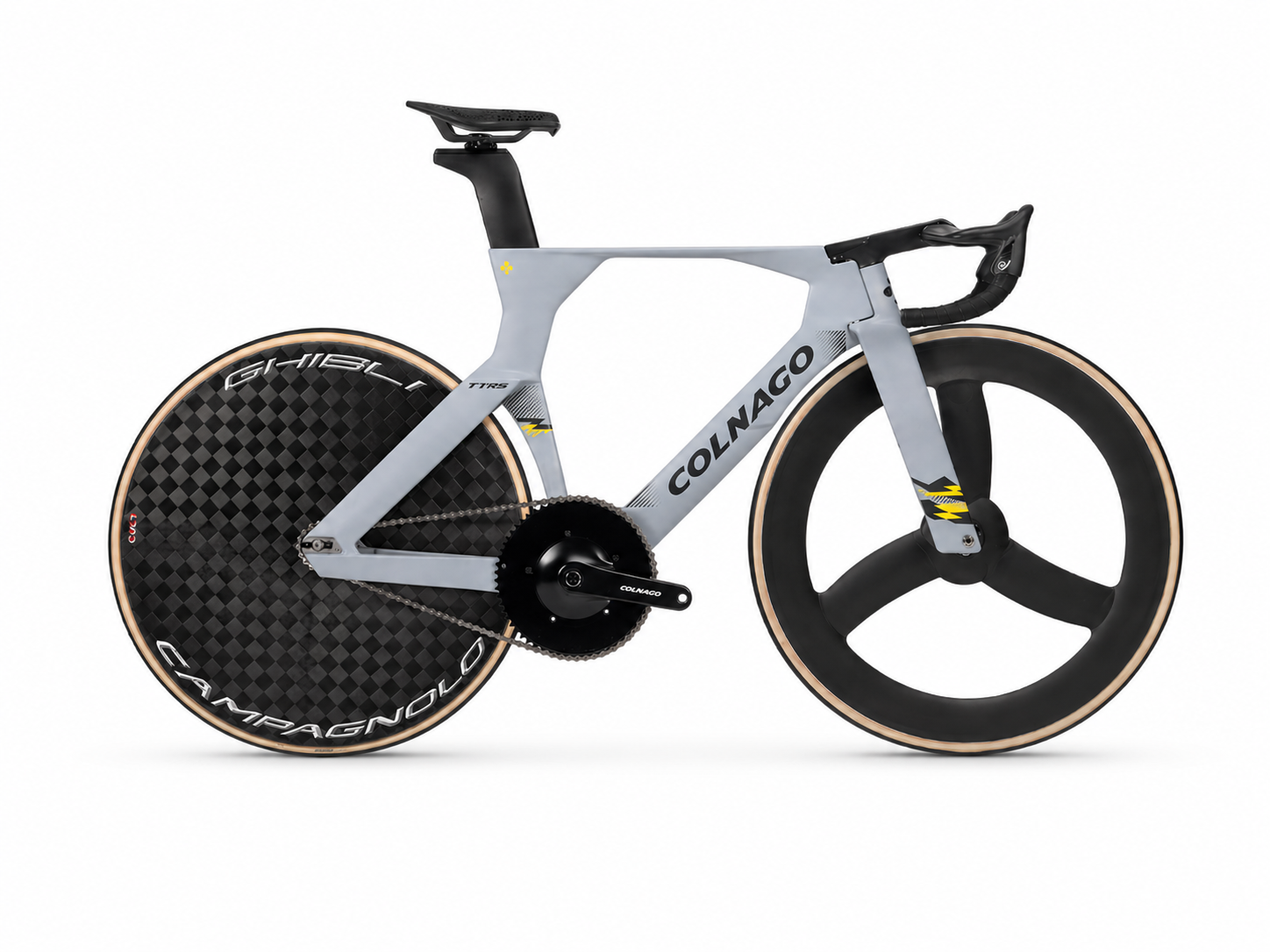
The Colnago T1Rs is not a complete answer on its own. That is the reality of every serious track bike. A frameset gives the shape, the geometry, the aerodynamic direction and the structural platform. The final bike is made somewhere else: in the wheel choice, the cockpit, the drivetrain, the chainline, the tyres, the gearing and the rider position.
That is especially true with the T1Rs.
Colnago's return to the track matters because the bike arrives at the right point in the LA 2028 cycle. It is current enough to feel relevant, early enough to be tested properly, and available enough to be built by riders, clubs and programmes outside the closed world of federation-only superbikes. But availability alone does not make a bike fast.
The build has to make sense.
A modern track bike is a system. Get that system right and the T1Rs becomes one of the most interesting elite-level platforms available to serious riders. Get it wrong and the frame will not save the project.
LA 2028-Ready Does Not Mean Olympic Fantasy
An LA 2028-ready track bike does not need to be a fantasy machine with unavailable parts and a price tag that belongs in a federation presentation.
It needs to be fast, legal, serviceable, coherent and realistic.
That means parts that can be sourced. Wheels that fit the frame. A bottom bracket that suits the chainset. A chain and drivetrain that can cope with track torque. Tyres that belong on a fast indoor velodrome. Handlebars that match the event, not just the photograph.
The point is not to copy what a gold-medal favourite may or may not ride in Los Angeles. The point is to build a bike that belongs to the same cycle of thinking: lower drag, better stiffness, stronger drivetrain efficiency and fewer weak decisions.
For most riders, that is where the real gain is, not in pretending to own a secret Olympic bike.
In building a serious one properly.

Start With The Job The Bike Has To Do
The wrong question is: what is the best Colnago T1Rs build?
The better question is: what job does my T1Rs have to do?
Sprint and bunch racing ask different things from the same platform. A sprint bike needs stiffness, front-end confidence and drivetrain strength under violent load. A bunch bike still needs speed, but it also needs control, repeatability, handling and a position that works when racing becomes messy.
The frame may be the same. The intent is not.
That is why the cockpit matters. That is why the same wheel package can mean slightly different things depending on how the bike is used. The T1Rs gives the rider a modern aerodynamic platform. The specification decides the character.
For this article, we are looking at two realistic LA 2028-cycle builds:
• a sprint-focused T1Rs
• a bunch-racing T1Rs
Not fantasy builds. Not generic builds. Proper track builds using serious, recognisable and readily available components.

The Shared Core: What Both Builds Get Right
The two builds share several major parts, and that is important.
Both use the same frame platform. Both use a CeramicSpeed T47 bottom bracket combined with the industry leading FSA Vision Track chainset and Izumi KAI Super Tough Track Chain.
Wheels are the same on both setups, a Princeton CarbonWorks Track Special Mach 7580 TS front wheel and a Campagnolo Ghibli 0.9 Track Disc rear wheel. Both using the TLR version of the Vittoria Pista Oro
That shared core is not accidental.
It creates a build around speed, compatibility and drivetrain quality rather than around isolated headline parts. It also reflects what the T1Rs needs. The bike is built around a narrow front architecture, so wheel choice is not something to guess. The result is a bike that feels coherent.
Track cycling punishes random builds. The T1Rs deserves better than that.
Sprint Spec: Built Around Load, Launch And Control
- Handlebars: Carbon Sprint Track Handlebar
- Chainset: FSA Vision Track Chainset - 165mm
- Chain: Izumi KAI Super Tough Track Chain
- Front Wheel: Princeton CarbonWorks Track Special Mach 7580 TS Front TLR Track Wheel
- Rear Wheel: Campagnolo Ghibli 0.9 Track Disc - TLR
- Tyres: Vittoria Pista Oro TLR
The Colnago T1Rs Track Bike - Sprint Specification is in stock and ready to ship today at Velodrome.Shop
A sprint build has to be judged from the first hard pedal stroke.
That is the truth of it. Sprint bikes are often talked about in terms of speed, but they are exposed first by load. The start, the first acceleration, the violent torque through the drivetrain, the rider throwing force through the bars and bottom bracket area. If a bike feels vague there, it does not matter how good it looks at 70 kph.
Bunch Spec: Fast, Aerodynamic And Still Raceable
- Handlebars: Carbon Aero Bunch Track Handlebar
- Chainset: FSA Vision Track Chainset - 165mm
- Chain: Izumi KAI Super Tough Track Chain
- Front Wheel: Princeton CarbonWorks Track Special Mach 7580 TS Front TLR Track Wheel
- Rear Wheel: Campagnolo Ghibli 0.9 Track Disc - TLR
- Tyres: Vittoria Pista Oro TLR
The Colnago T1Rs Track Bike - Bunch Race Specification is in stock and ready to ship today at Velodrome.Shop
A bunch-racing T1Rs has a different brief.
It still needs speed. It still needs stiffness. It still needs aerodynamic quality. But bunch racing is not a straight-line test. The bike has to live in traffic, respond to changes in pace, hold position, move through gaps and remain controllable when the race becomes sharp.
For the bunch build, there are two clear cockpit upgrade paths:
• Carbon Aero Bunch PRO Track Handlebar
• FSA Vision Metron Handlebars
This is where the bunch bike can be tuned to the rider.
A more advanced aero bunch bar can make sense for a rider who wants a sharper, more race-specific front end. The FSA Vision Metron route may suit riders who prefer that particular cockpit feel, fit language or brand ecosystem. The important point is not that one handlebar is automatically right for everyone. The important point is that bunch racing still deserves a deliberate cockpit decision.
Why The Same Wheels Work Across Both Builds
The shared wheel package is one of the more interesting parts of these specifications.
A Princeton CarbonWorks Track Special Mach 7580 TS front wheel and Campagnolo Ghibli 0.9 Track Disc rear wheel gives both bikes a very serious race profile. On the sprint build, that means aerodynamic speed with enough presence and stiffness for high-load efforts. On the bunch build, it means a more aggressive race setup than the traditional conservative wheel choice.
The reason this works is simple: the T1Rs is not being built as a training bike.
It is being built as an LA 2028-cycle race platform.
That does not mean every rider will use the same wheels every day. Campagnolo Pista 65 wheels can be used for training or if the rider wants a spoked option for racing. But as the headline build, this wheel package matches the ambition of the frame.
It also avoids one of the common mistakes with expensive framesets.
A rider buys the frame, then compromises the wheels. The final bike looks high-end but performs like a half-finished project. The T1Rs deserves wheels that match the aerodynamic purpose of the chassis.
The T1Rs Is A Platform, Not A Shortcut
The strongest argument for the Colnago T1Rs is not that it removes complexity.
The strongest argument is that it gives serious riders a platform worth building around. That is different. It means the rider, mechanic or programme still has to make good decisions. It means compatibility matters. It means the cockpit cannot be guessed. It means the drivetrain cannot be treated like a finishing kit. It means the wheels must belong to the frame.
Track cycling has never rewarded shortcuts for long. The best bikes are not just fast in the catalogue. They are fast because every major decision points in the same direction.
The Colnago T1Rs has the timing, shape and credibility to matter in the LA 2028 cycle. These builds show what that can look like in practice: not a federation fantasy, a serious modern race bike assembled with intent.
A frame can start the conversation, the build decides whether the bike is ready.
The Colnago T1RS is in stock and ready to ship today at Velodrome.Shop


