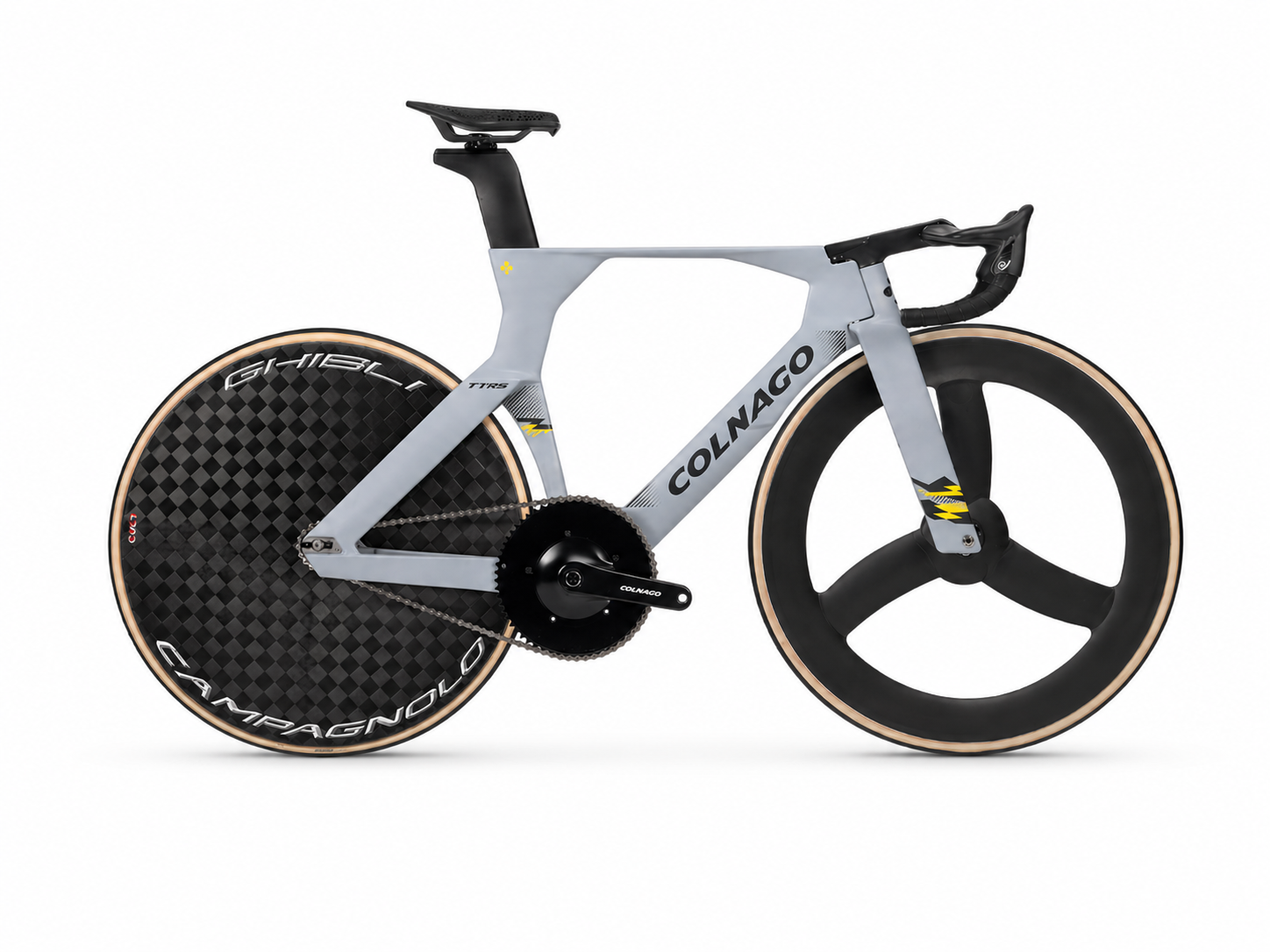
The Colnago T1Rs is not yet everywhere.
That is the first thing to understand. It has not dominated a World Championships. It has not become the default bike of the World Cup. It has not yet acquired the repeated visual proof that turns a frame into part of the furniture of elite track cycling.
For now, it sits somewhere more interesting: between launch and adoption.
Track bikes do not become Olympic bikes overnight. Riders test. Coaches watch. Mechanics measure. Federations weigh up cost, availability, geometry, support, spares, wheel compatibility and risk. Amateur riders do the same, only with less budget and fewer people around them. By the time the Olympic year arrives, most serious equipment decisions have already hardened.
Los Angeles 2028 is not as far away as it looks. Under the UCI's LA28 track equipment registration procedure, critical equipment such as frames, forks, wheels, cockpits and helmets must move through a formal 2027 registration, inspection and use process before appearing on the final LA28 equipment list in 2028. That makes 2026 and early 2027 the real decision window, not the warm-up act.
Colnago's return to the track with the T1Rs, launched in late 2025, therefore lands at a useful point in the cycle. The bike is early enough to be tested, adopted, refined and normalised before LA. It is late enough to feel current. It is not an old platform being stretched towards one more Games. It is a new one arriving as riders and programmes begin to decide what the next Olympic build should look like.
That timing may prove to be its real advantage.
Track Cycling Has A Superbike Problem
The top end of track cycling has become increasingly difficult to read.
Some of the most talked-about bikes in the sport are barely normal products at all. They are Olympic projects, national-federation machines, technical statements and political objects as much as framesets. They appear under selected riders, at selected events, with selected support. They shape the visual language of the sport, but they do not always shape the market beneath it.
That creates a gap.
Serious riders still need real equipment. So do smaller national programmes, amateur endurance specialists and sprinters trying to bridge the next level. Not everyone can access a federation-only superbike. Not everyone can justify a closed ecosystem. Not everyone wants a bike that is spectacular in theory but awkward in practice.
The middle of the elite track market has become strangely important.
Not the beginner market. Not the fantasy end. The space in between: fast enough to belong in serious racing, available enough to buy, adaptable enough to build properly, and credible enough that a rider does not feel they are turning up already behind.
The T1Rs is directly aimed at that space as a more accessible high-performance track platform, with the frameset configurable for sprint, endurance and pursuit use through different bar and stem options.
No national federation has yet made Colnago track bikes part of its public identity. That does not mean the bike is being ignored. Colnago has already spoken publicly about federation interest and its willingness to provide material for testing. The T1Rs has not returned to defend an established place in the track peloton. It has returned to take one.

A Different Kind Of Olympic Candidate
The T1Rs is interesting because it does not seem to be trying to win the superbike arms race by copying its most extreme language.
Colnago has gone narrow rather than adopting the very wide fork and rear-end philosophy associated with some recent Olympic machines. The T1Rs uses narrow hub spacing - 65 mm at the front and 100 mm at the rear - as part of an aerodynamic package designed to reduce frontal area.
That choice gives the bike a distinct identity.
It is not trying to look like every other national project. It takes the recognisable direction of modern aero road and time-trial development, then translates it into a track-specific frame: deep sections, integrated front end, reinforced rear triangle and narrow system architecture. Colnago's own product material describes the T1Rs as a monocoque carbon frame with a carbon dual-crown fork, designed to reduce air resistance at high speed while maintaining stiffness.
There is a quiet practicality in that.
Track cycling is full of equipment that looks spectacular until a mechanic has to build it, travel with it, replace a part or make it work for a rider who does not fit the launch photograph. The T1Rs still has specialist requirements, particularly around wheel compatibility, but it is not presented as a closed mystery. It is a frameset. It is a system. It can be built.
That sounds simple. In this market, it is not.

The LA 2028 Window Is Opening Now
Olympic equipment stories are usually written backwards.
The public sees the bike when the medals are being won. The real story began much earlier. It began when a rider first tested the position. It began when the federation decided whether to standardise around a platform. It began when an amateur rider took a risk on a frameset before everyone else had copied the decision.
By the time riders arrive in Los Angeles, the equipment hierarchy will already be largely set. The bikes that appear common in LA will not have become common that week. They will have become common through the two years before it: through domestic championships, World Cups, training camps, private testing, federation orders and quiet word of mouth.
The T1Rs has enough time to move.
It is not arriving in Olympic year, when risk becomes too expensive. It is not arriving so early that its technology feels dated before the Games. It appears in the useful middle: close enough to LA to feel relevant, far enough away for riders and programmes to adopt it without panic.
That is where popularity can start.
Not with a dramatic launch. Not with one professional appearance. With repetition. A rider buys one. A programme tests one. A mechanic sees that the build makes sense. A coach notices the rider can hold the position. A second rider follows. Then the bike begins to appear in the background of training photos, national championships and World Cups.
Track cycling adoption often looks sudden only because most of the decision-making happened out of sight.
One Platform, Several Jobs
The T1Rs also has a useful advantage in a sport where riders and programmes rarely buy equipment for one neat category.
Colnago presents the bike with both sprint/endurance and time-trial/pursuit configurations. The pursuit setup uses a monocoque carbon stem and base bar unit, while the sprint and endurance build uses a different stem and your own handlebar arrangement.
A smaller national programme does not always want three separate frame philosophies. An amateur rider certainly does not. A sprint rider may care most about front-end stiffness and standing start response, while an endurance rider may be looking at aerodynamic stability and postural efficiency. The T1Rs does not answer all of those demands in the same way, but it gives the buyer a single platform from which several serious builds can be created.
That makes it easier to justify.
It also makes it easier to see why the bike could spread. A pure pursuit machine has a narrower market. A pure sprint bike has a narrower market. A general track frameset that can be built credibly across disciplines has more routes into the sport.
For LA 2028, that versatility could count.

The Bike Does Not Need To Be Everywhere Yet
There is a temptation with new equipment to ask the wrong question too early.
Who is riding it now?
A bike launched into the elite track market does not instantly become visible at the top of the sport. Federations have existing supply chains and a deeper process is required for new equipment. Mechanics are conservative for good reason. Nobody serious changes bikes because the launch photography was good or a famous rider is using a new product.
The better question is this: What problem does the bike solve?
The T1Rs solves several at once. It gives Colnago a modern track platform again. It gives riders access to a serious current-generation frameset without entering the least accessible end of the superbike world. It gives programmes a brand with global recognition, a platform with sprint, endurance and pursuit logic, and a bike timed properly for the LA cycle.
Colnago has tested different design directions, including the wide-stance approach, before choosing the narrower solution. It has also made clear that the T1Rs is being aimed at the Los Angeles cycle rather than launched as a nostalgic side project.

Why Popularity May Come From Outside The Obvious Places
The first wave of adoption may not come from the biggest federations.
That is often how track cycling works. The most powerful nations may already have their own technical routes, existing partners and internal projects. Their bikes attract attention because they are visible, but they do not necessarily define what the rest of the sport can buy.
The T1Rs may be more interesting to the layer beneath that.
Ambitious national programmes without a locked-in superbike project. Federations needing a credible platform without inventing one. Amateur riders chasing a dream. Serious customers who want something beyond a traditional track frame but still need a bike that can be ordered, built and supported.
That is a big market by track cycling standards.
It is also a market that influences what appears at an Olympic Games. Not every LA 2028 bike will sit under a gold-medal favourite. Many will sit under riders fighting through qualifying rounds, continental pathways, repechages, bunch races, flying laps and personal bests. The visual popularity of a frame is not only decided by medal winners. It is decided by how many riders and programmes trust it enough to turn up on it.
That is where the T1Rs could become highly visible.
The Build Still Matters
None of this means the frame alone is enough.
A modern track bike is not a single product. It is a system of frame, fork, cockpit, wheels, chainset, bottom bracket, chainline, chainring size, tyre choice, position and rider. Get that wrong and even a superb frame becomes an expensive mistake.
The T1Rs has specific build implications, wheel choices are limited but by no means limiting.
Spoked Front and Rear - Campagnolo Pista 65 Carbon Track Wheels
Rear Disc - Campagnolo Ghibli 0.9 Track Disc
Front and Rear Disc- Princeton CarbonWorks Track Special Hour Record Track Disc
Front 3 Spoke - Princeton CarbonWorks Track Special Mach 7580 TS Front TLR Track Wheel
Crucially, those are not obscure compatibility paths. Readily available products from major brands can work with the T1Rs, which means the narrow aerodynamic setup does not leave the rider trapped inside a theoretical system.
The Track Bike That Arrived Before The Rush
LA 2028 will create noise.
Olympics always do. New bikes, new shapes, new claims, new photographs, new debates over legality, price and advantage. The Olympic track is where engineering becomes theatre. Every Games has its visual symbols. Every cycle produces a new argument over what speed should look like.
The Colnago T1Rs may not be the loudest bike in that conversation.
It may be something more useful: a bike that arrived before the rush, with enough time to be understood, tested and adopted. A bike from a brand with history, but not trapped by it. A platform that sits below the absurd end of the market but above ordinary compromise.
That is why Colnago's return to the track feels well timed.
Not because the T1Rs is already everywhere. Not because it has already proved itself as the bike of LA 2028. It has not. The point is more subtle than that.
The T1Rs has entered the sport at the moment when riders and programmes are beginning to choose what the LA cycle will look like.
You can be part of that change now, the Colnago T1RS is in stock and ready to ship today at Velodrome.Shop


