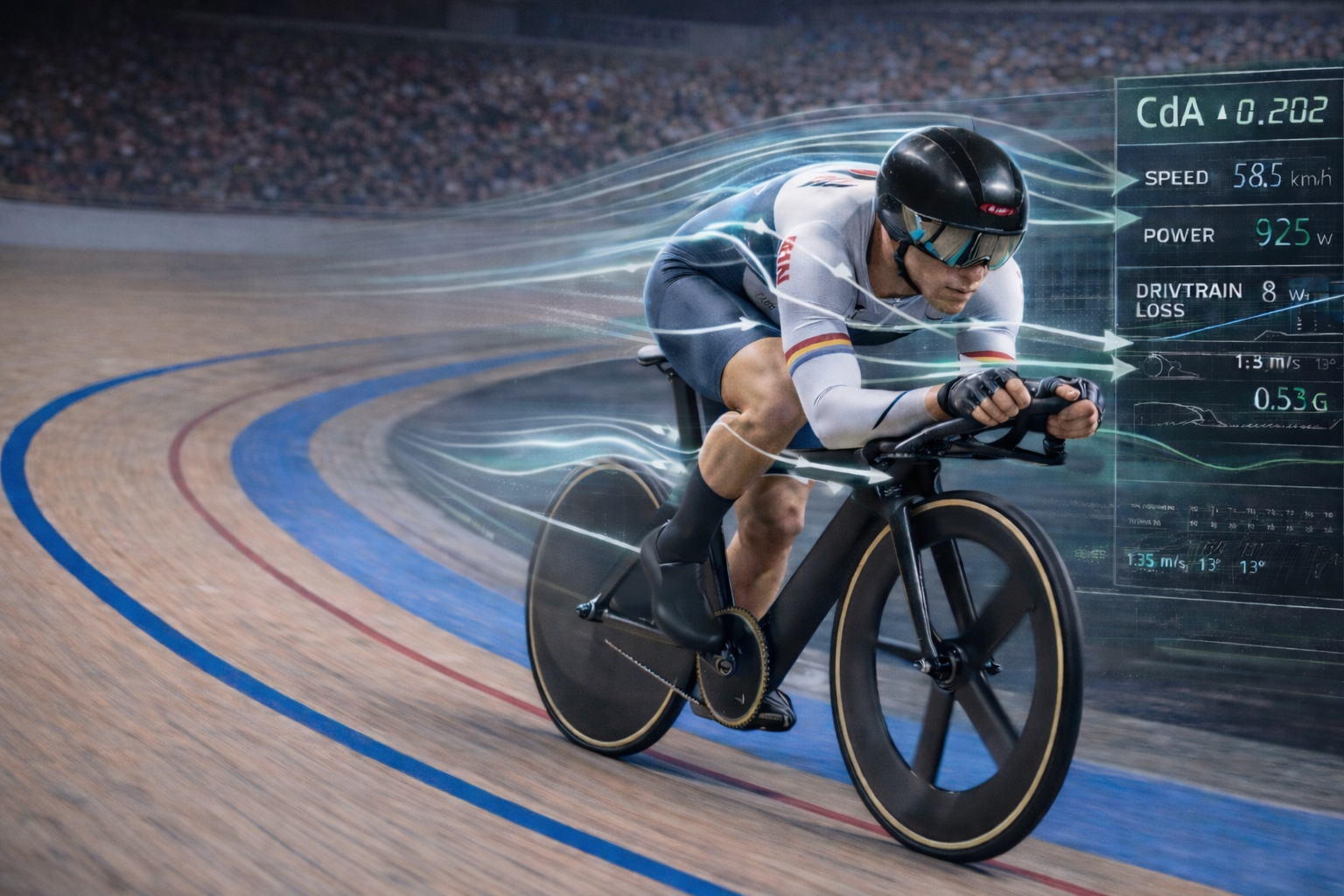
The old argument no longer holds. This is not a category waiting to prove its seriousness. The riders are too good for that. The equipment demands are too precise. The classification detail is too exacting. The tandem partnerships are too important. The coaching load is too heavy. None of this belongs to a side project.
The problem sits higher up. National systems in some countries have started behaving as though para-track matters. The international structure still has not caught up.
National systems are already ahead of the calendar
In the United States, USA Cycling has published a dedicated 2026 para-track national calendar and framed it in performance terms: classification opportunity, athlete development and higher-level race exposure on the way to championship racing. Britain has moved in the same direction. British Cycling's 2025-26 National Track Series includes a para-cycling league, and the 2026 National Track Championships schedule placed para events directly into the main programme. Glasgow 2026 has gone further still, describing para-track as fully integrated into its track event.
Domestic track has already answered the legitimacy question. Para-track is no longer waiting outside the sport asking to be let in. In the better examples, it is already inside the architecture.
Domestic track has answered the legitimacy question. The UCI calendar still has not.
The real weakness is the missing middle
The UCI has restored a three-round Track World Cup for 2026 in Perth, Hong Kong and Nilai. Para-track still has no equivalent series beneath the Para Cycling Track World Championships in Apeldoorn. That is the real gap. Not prestige at the top. Structure underneath it.
A discipline does not become healthy because it can point to a world championship. It becomes healthy when there is a ladder below it.
Para-track still lacks that ladder. In the stronger countries, riders can reach nationals. The best can reach Worlds. What remains too thin is the ground in between: repeated international exposure, ranking pressure, field depth, reliable selection evidence, race rhythm, genuine rehearsal under travel and competition conditions. For a discipline as technical as track cycling, that is not a minor scheduling flaw. It shapes what athletes and programmes are allowed to become.
Track racing punishes thin structure. Starts, pacing, exchanges, pilot chemistry, tandem timing, equipment refinement, judgement under pressure - none of it is best served by a calendar that asks athletes to spend long periods preparing for very few meaningful international targets.
Funding sharpens the contradiction
The awkward question sits with the bigger federations.
UK Sport's current funding awards list £8.825 million for Para-Cycling for the Los Angeles 2028 cycle, excluding Athlete Performance Awards. That is not a para-track-only figure, and it is not annual. A World Class Programme funded at that level ought to feed into more than a domestic championship and a world championship on the track.
This is not an argument against funding. It is an argument for taking funding seriously.
Serious backing is supposed to create a performance environment. It is supposed to buy repetition, rivalry, calibration, selection clarity and international race pressure before the one week when medals count. When the calendar remains this thin, the programme starts to look more complete on paper than it does in practice.
A serious programme should not be aimed at a near-empty season.
The UCI cannot hide behind complexity
The practical objection is obvious enough. The current Track World Cup is already dense: three rounds, three-day weekends, the full Olympic programme, broadcast pressure and tight venue scheduling. A full mirror-image para-track World Cup across every classification and every round does not look realistic in the present format.
That does not absolve the UCI of responsibility. It sharpens it.
The UCI aims for cycling to be an open and accessible sport committed to gender equity, diversity and inclusion. It has also said equality, diversity and inclusion are interwoven into its policies and documents, and that inclusivity and accessibility should be embedded into event planning. Those are not decorative lines to be rolled out for host-city pledges and major events. They create an obligation to build structure where structure is missing.
Para-track does not need the UCI to speak more warmly about inclusion. It needs the UCI to organise an international season that reflects those stated values.
One annual para-track World Cup, or one UCI-recognised para-track international round beneath Worlds, is not a grand demand. It is close to the minimum a serious discipline should now expect.
A para-track block inside the World Cup
A full parallel para programme across every World Cup round is not feasible in the current model. A more realistic first step would be to integrate a compact block of para-track racing into one Track World Cup weekend. That would create a first international rung without pretending the entire structure can be solved in one move.
Tandem racing is the cleanest route in.
B events are easier for a broad audience to read immediately than a full classification map introduced all at once. They are visually obvious, easy to explain and naturally dramatic. They also fit the way track cycling is normally presented: speed, precision, teamwork, timing, jeopardy. Tandem sprint and tandem pursuit would give the UCI a realistic way to start building para-track into the World Cup environment without reducing the discipline to a token showcase.
A compact para-track block inside one World Cup weekend would be a serious beginning for 2027: visible enough to matter, small enough to stage properly, and substantial enough to test whether the UCI is prepared to build more.
The first step does not need to be everything. It needs to be real enough to count.
Grenchen would be an obvious place to start
The Tissot Velodrome has recent form as a major international venue. It hosted the 2022 UCI Track World Championships, the 2023 European Track Championships, and it continues to stage UCI-recognised international track racing. The UCI para-cycling calendar also shows para-track events in Grenchen through the Track Cycling Challenge. That does not make Grenchen the only possible answer, but it makes it a credible one. An annual para-track World Cup or pilot para-track international round there would be a serious test, not an improvised experiment.
There is also a broader logic to that choice. A proven indoor venue. Existing international race culture. Familiarity for the sport. Enough credibility for the event to be judged on sporting value rather than on whether the host was capable of staging it.
Grenchen's proximity to the UCI's base in Aigle only strengthens the case. A pilot para-track World Cup there would be difficult to dismiss as impractical.
Para-track no longer needs symbolic sympathy. It needs competent placement.
The absence now looks like a choice
A few years ago, para-track could still be discussed as a discipline waiting for shape. That argument is weaker now.
USA Cycling has built a national calendar. British Cycling has built para-track into its domestic series and championship structure. Glasgow 2026 is presenting para-track as integrated competition, not administrative decoration. The athletes, coaches and programmes have moved forward. The international calendar has not moved far enough with them.
What once looked temporary now looks structural. Not because anyone has openly argued against para-track. Not because the sport lacks proof. Because year after year the discipline is still left with nationals in some countries, a world championship at the top, and too little of substance in between.
That is why para-track still has no real international season.
Not because the riders are not there.
Not because the standards are not high enough.
Not because integration is impossible.
Because the architecture is still too thin for the level of performance now being demanded.
Para-track is no longer asking for visibility. It is asking for structure, and that is the responsibility of the UCI to build.