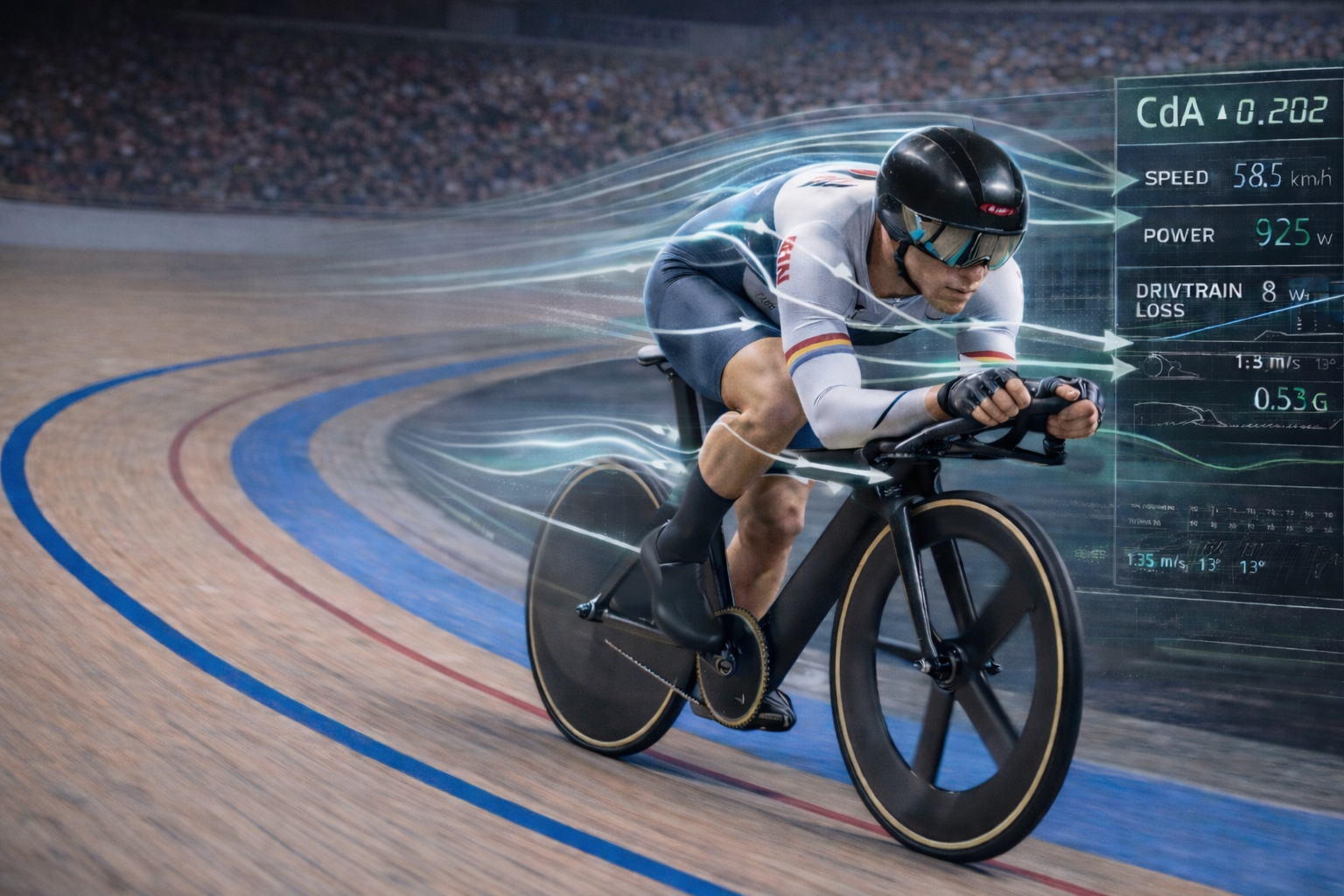
Lorena Wiebes could have treated the track as useful, occasional and secondary. That would have been understandable.
She is not a rider searching for relevance. She is not a road sprinter looking for a new identity because the old one has stopped working. Wiebes already has one of the most feared finishes in the women's peloton. Her presence changes the behaviour of a race before the sprint has even begun. Lead-out trains think about her. Rivals think about her. Teams build final kilometres around either delivering her or stopping her.
The track did not need to rescue Lorena Wiebes.
She chose it anyway.
That choice is becoming one of the more revealing stories in modern track cycling. Not because it proves every road rider should return to the boards. Not because it gives the sport a neat development-pathway slogan. It matters because it shows what the velodrome can still offer a rider who already has plenty.
It can offer an Olympic route. Not in theory. In structure.
The road may still offer Wiebes a chance. The track offers her a campaign.
Wiebes can win Olympic road gold in theory. That point should not be brushed aside. A rider with her speed, timing and race intelligence should never be written out of a one-day race before the route is known. If an Olympic road race gives the sprinters enough room to survive, she belongs in the conversation immediately.
Recent Olympic road races have not been built for that kind of rider.
Tokyo was hard, hilly and attritional. Paris was selective, with repeated climbing, technical city racing and the Montmartre circuit pulling the race towards riders who could absorb repeated accelerations long before the final sprint. Los Angeles has confirmed a Venice Beach start and listed a women's road race of around 150km, but the full route profile has not yet been revealed. The final shape may still matter enormously to Wiebes, but the recent direction of Olympic road racing is clear enough to make the calculation serious.
The road may still give her a chance. The track gives her a project she can shape.
This is not a side project
Wiebes' first world title on the track could have been filed away too easily.
At Ballerup in 2024, she arrived at the Track World Championships and won the scratch race. A road sprinter with that much finishing speed winning a scratch race can sound almost simple after the fact. Stay alive. Stay patient. Find the right wheel. Move at the right moment. Finish with authority.
The interesting part was not only that she won. It was how quickly the win stopped looking like a one-off. She did not take the rainbow jersey, smile at the novelty of the velodrome, and disappear back into the road season as if the track had served its purpose. She went deeper.
European omnium champion. Scratch silver. Another world scratch title. Then a world omnium title.
The scratch race gave Wiebes a doorway. The omnium gives her an Olympic destination. The Madison gives her another route into the same conversation. Piece by piece, the velodrome is becoming less like a useful addition and more like a genuine part of her ambition.
Modern cycling loves versatility when it can be packaged neatly. Road, gravel, track, cyclo-cross, a few rainbow bands across disciplines, a social-media friendly sense that a rider can win anywhere. Wiebes can fit that story if required. She has the range. She has the results.
The track project feels more serious than that.
The omnium is not a branding exercise. You can't just turn up and hope to win
Why the omnium changes the question
The omnium does not ask whether Wiebes is fast. Everyone already knows that.
It asks whether she can keep making good decisions after the day has started to take pieces out of her. The scratch race rewards positioning, timing and nerve. The tempo race changes the rhythm and forces calculation. The elimination race is a pressure chamber, with no room to drift, no space to hide and no tolerance for poor instinct. The points race then turns fatigue into arithmetic. Every sprint, every lap, every move has meaning. A rider can be strong and still lose the event by reading it badly.
That is why Wiebes' move towards the omnium is more than an extension of her road sprint.
It is an expansion of her competitive range.
On the road, Wiebes is used to being marked. On the track, she is marked in a smaller room. Everyone knows where the finish speed is. Everyone knows what happens if she is still close enough when the decisive sprint arrives. That changes the race around her. Opponents do not simply race the event. They race the threat of Wiebes still being there at the end.
So she has to win before she wins.
She has to hold position without wasting energy. She has to decide when a move is dangerous and when it is only noisy. She has to survive the phases of an omnium that do not naturally flatter a pure finisher. She has to make her sprint matter after the race has already asked for patience, judgement and control.
That is a proper Olympic problem.
It is also why the track is not a soft option for her. It is not the easier route to gold. It is the route where her best qualities are more likely to be central, but where they are not enough on their own.
For a rider of Wiebes' standing, that is the appeal.
The track is not asking Wiebes to prove she is fast. It is asking whether her speed can survive a different kind of examination.
The road can make her dominant. The track can change her range.
Wiebes already has status on the road.
She does not need a velodrome to make people understand her finishing speed. She does not need a track programme to prove she can close bike races. The road has given her wins, visibility, pressure and authority. It may still give her more.
Olympic road racing is different from road racing in general.
A trade-team sprint win can be designed. A classics campaign can be targeted. A stage finish can be shaped by a team that knows exactly what it is trying to deliver. An Olympic road race is less obedient. It appears once every four years, on a course chosen for a different set of reasons, with national teams rather than trade-team machinery, and with no second chance if the route does not suit.
For Wiebes, that is the harsh part.
Her talent is obvious, but Olympic road opportunities are not guaranteed to meet that talent in the right form. A hilly, selective road race does not remove her from contention entirely, but it shifts the race away from her strongest lane. It turns the Olympic dream into something dependent on course design, race shape and survival.
The track is different.
The omnium and Madison do not guarantee anything. Jennifer Valente has made Olympic track racing her territory. Ally Wollaston, Lotte Kopecky, Amalie Dideriksen, Marion Borras and a deep field of road-track specialists and full track endurance riders will not arrange themselves around a Wiebes storyline. The Madison adds another layer again: exchanges, trust, timing, shared instinct, and the ability to stay calm while the race becomes almost unreadable from the outside.
Still, the track gives Wiebes a campaign she can build.
A rider cannot control the eventual Olympic road route. She can control whether she becomes a better omnium rider. She can control how much time she gives to the elimination race, to points-race reading, to Madison rhythm, to the specific pressure of racing on the boards when everyone knows she is the rider with the finish.
That is not diversification for its own sake. That is strategy.
The prize inside the velodrome
Track cycling has spent too much of the modern era being asked to justify itself to the road.
The questions usually come in practical language. What does it give back? Does it improve the rider? Does it sharpen race craft? Does it fit the calendar? Does it interfere with trade-team priorities? Does it produce UCI points that matter to road teams?
Those questions are not stupid. They are just incomplete.
Wiebes is showing that the track still has value even when it is not acting as a service department for the road. Its worth is not only in what it sends back to road racing. Sometimes the velodrome matters because the prize inside it is big enough on its own.
Olympic gold is still that kind of prize.
It has a different weight from another road win, even for a rider who wins a lot. It is rarer. It is national. It changes how a career is remembered. It can sit beside the road palmares not as decoration, but as a different kind of proof.
That is what makes this journey compelling.
Wiebes is not stepping down into a smaller arena.
She is stepping sideways into a harder question. Can one of the best finishers in the world become an Olympic track champion?
Wiebes is not using the track because the road has failed her. She is using it because the track offers a prize the road may not place within reach.
LA 2028 gives the ambition a date
Los Angeles gives all of this shape.
Without the Olympics, Wiebes' track success would still be impressive. With the Olympics ahead, it becomes directional. Ballerup can be read as the beginning. The European omnium title as proof of seriousness. Santiago as the moment the project stopped looking speculative. The Madison work as the broadening of the route.
The calendar now has a centre of gravity.
That does not mean Wiebes will abandon the road or become a track specialist in the old sense. That would miss the point. Her strength is that she is not entering this from weakness. She is not leaving one world because it has failed her. She is adding another because it offers something the road may not.
The sport does not need to beg for relevance by pretending it is always useful to the road. It should be confident enough to say that, for the right rider, the velodrome still contains something irreplaceable. A different rhythm. A different pressure. A different medal. A different version of the same athlete.
Wiebes seems to see that.
She is not treating the track as a lesser ambition. She is treating it as a chance at Olympic gold that can be built with intent.
Worth the disruption
The road calendar will always make this complicated.
Trade teams have their own priorities. Seasons are long. The demands on a rider like Wiebes are constant. Every track block has an opportunity cost. Every national-team ambition has to live alongside commercial road commitments. None of this is simple, and it should not be written as if the velodrome magically solves the Olympic problem.
That is what gives the choice meaning.
If Wiebes had nothing else to chase, the track would look like an obvious route. She has plenty to chase. That makes the commitment more telling. She is taking on complexity because the possible reward is worth it.
That is the line track cycling should care about.
Worth it.
Not convenient. Not risk-free. Not guaranteed.
Worth it.
At a time when road cycling often measures the track by what it fails to deliver in direct road value, Wiebes is showing something more personal and more powerful. She is not asking whether the track can support her road career. She is asking whether the track can help define the next part of it.
That is a very different question.
The road may still give Lorena Wiebes many things. Wins, status, more proof, more fear. Perhaps even an Olympic chance if the route finally gives her the right kind of race.
The track gives her something she can start building now.
An Olympic campaign shaped around speed, instinct, repeatability and nerve. A campaign where the prize is clear, the events are known, and the work can become specific.
Wiebes has already won enough to avoid that world.
She is choosing it anyway.
That is not a side project.
That is ambition.